AI Knows Your Brand. But Would It Recommend You?
I tested 10 technical B2B SaaS brands across ChatGPT, Gemini, Claude, and Perplexity. The main failure was not hallucination. It was that AI often understood yesterday’s positioning better than today’s.
Research10 min
AIB2B SaaSBrand StrategyPositioningProduct MarketingAI Search

Most AI brand audits start with an easy question: Does ChatGPT know who we are?
I am not sure that question tells marketers very much anymore.
For established B2B software companies, an AI assistant can usually recognize the company, identify its broad category, and summarize the product without making an obvious factual mistake. That can create a false sense that the brand is represented correctly.
The more useful question is harder: What does AI associate your company with when a buyer is deciding what to buy?
I tested that distinction across 10 technical B2B SaaS brands. First, I asked AI systems to explain each company directly. Then I removed the company names and gave the systems buying scenarios designed around those companies’ current products and positioning.
The results suggest that AI brand visibility has at least four separate layers: recognition, understanding, discovery, and preference. A company can perform well at one and fail at the next.
And the most interesting failure mode was not AI inventing things.
It was AI being perfectly reasonable about a version of the company that had already moved on.
What I tested
On October 7, 2026, I tested Vercel, Grafana Cloud, n8n, PostHog, Sentry, Supabase, Flagsmith, Prerender.io, Dash0, and Checkly.
I ran the experiment across ChatGPT, Gemini, Claude, and Perplexity. The configurations were ChatGPT Free with reasoning enabled, Gemini 3.1 Pro, Claude Sonnet 5.5 at medium reasoning, and Perplexity in its default mode.
This was not designed as a model benchmark. The products did not have identical browsing, retrieval, or reasoning configurations, so comparing their raw “accuracy” as if they were running under laboratory conditions would be misleading.
Instead, I wanted to reproduce something closer to the real situation a buyer creates: different people use different AI products, with different retrieval systems, and they expect reasonably current answers.
Each company went through two tests.
In the branded test, I named the company and asked what it was, what category it belonged to, who it was for, what problem it solved, its major capabilities, and which products a buyer would realistically compare it with.
In the unbranded test, I removed the company name and described a buying problem that closely matched the company’s current positioning. Each AI system had to recommend and rank three to five products.
That produced 80 observations: 40 branded answers and 40 unbranded recommendation scenarios.
For the branded answers, I also compared what the models said with the companies’ current first-party positioning. I classified each response as current, mixed, or legacy. “Legacy” did not mean false. It meant the answer was still broadly correct, but it mostly represented the product or category the company had historically been known for rather than the newer strategic direction.
That distinction turned out to matter.
Recognition was not the problem
All 40 branded queries recognized the correct company.
There were no meaningful cases where an AI system confused Sentry with another company, failed to understand what Supabase was, or completely invented what n8n did.
That makes simple brand recognition a weak metric for this set of companies.
If an AI visibility dashboard tells a reasonably established B2B software company that ChatGPT “knows” its brand, that may be true. It may also be almost irrelevant.
The harder question is whether the system understands the version of the company that marketing and product teams are trying to establish now.
On that measure, the results were much less clean.
Of the 40 branded answers I coded, 9 reflected the company’s current positioning well, 15 were mixed, and 16 mostly reflected legacy positioning.
In other words, the common problem was not that AI had the wrong company.
It often had the right company with an older mental model.
AI can be factually correct and strategically outdated
Vercel is an unusually clear example.
Ask what Vercel does and “frontend cloud,” Next.js deployment, preview environments, serverless compute, and global delivery are all reasonable answers. That is the company people have known for years.
But Vercel’s current company-level positioning is materially broader. It now describes itself as “agentic infrastructure for every app and agent”, with an explicit strategy around infrastructure for coding agents, building and running agents, and infrastructure that can itself act agentically.
The branded AI responses largely recognized the historical Vercel very well. Gemini called it a “frontend cloud platform and hosting provider.” Claude described a cloud platform for building and deploying web applications. Perplexity classified it as Frontend Cloud / deployment and hosting infrastructure.
Those answers were not hallucinations.
They were lagging indicators.
n8n showed a similar pattern. Its older category description — workflow automation or iPaaS — is still accurate, but its current homepage leads with “AI agents and workflows”, while its AI product positioning emphasizes production-ready agents, human-in-the-loop controls, code, self-hosting, and multi-agent systems.
Several branded answers still treated those AI capabilities as an extension of the automation product rather than a central part of what n8n is trying to own.
PostHog is moving even further from its old category label. It is still strongly associated with product analytics, but its current products page describes “devtools and product data infrastructure for building self-driving products.” Product analytics now sits alongside replay, feature flags, experiments, error tracking, AI observability, and a wider product data layer.
Again, “product analytics platform” is not wrong.
It is incomplete in a strategically important way.
Supabase produced another version of the same problem. “Open-source Firebase alternative” and “backend as a service” remain common descriptions, but Supabase now explicitly calls itself an open-source Postgres development platform, emphasizing standard Postgres, composability, direct database access, and lower lock-in.
This is why factual accuracy alone is not enough for a brand audit.
An answer can contain no obvious errors and still fail to reflect the category, problem, or narrative a company is currently investing in.
The more useful test was to remove the brand name
The second test was closer to a commercial question.
Instead of asking “What is Vercel?” I described a Next.js and React team that needed managed deployment, preview environments, global delivery, server-side compute, and infrastructure suitable for coding agents.
Instead of asking “What is Sentry?” I described a software team that needed error monitoring, tracing, replay, code-level debugging, and AI-agent telemetry.
Instead of asking “What is Dash0?” I described an OpenTelemetry-standardized engineering team that wanted an AI SRE capable of investigation, root-cause analysis, and increasingly autonomous remediation.
Then I asked each system to recommend and rank products.
Across these deliberately high-fit scenarios, the intended brand appeared in 37 of 40 shortlists, or 92.5%. It ranked first in 33 of 40.
Those numbers should not be interpreted as general AI market share. The prompts were intentionally designed around the target companies’ capabilities.
The more interesting result was where the pattern broke.
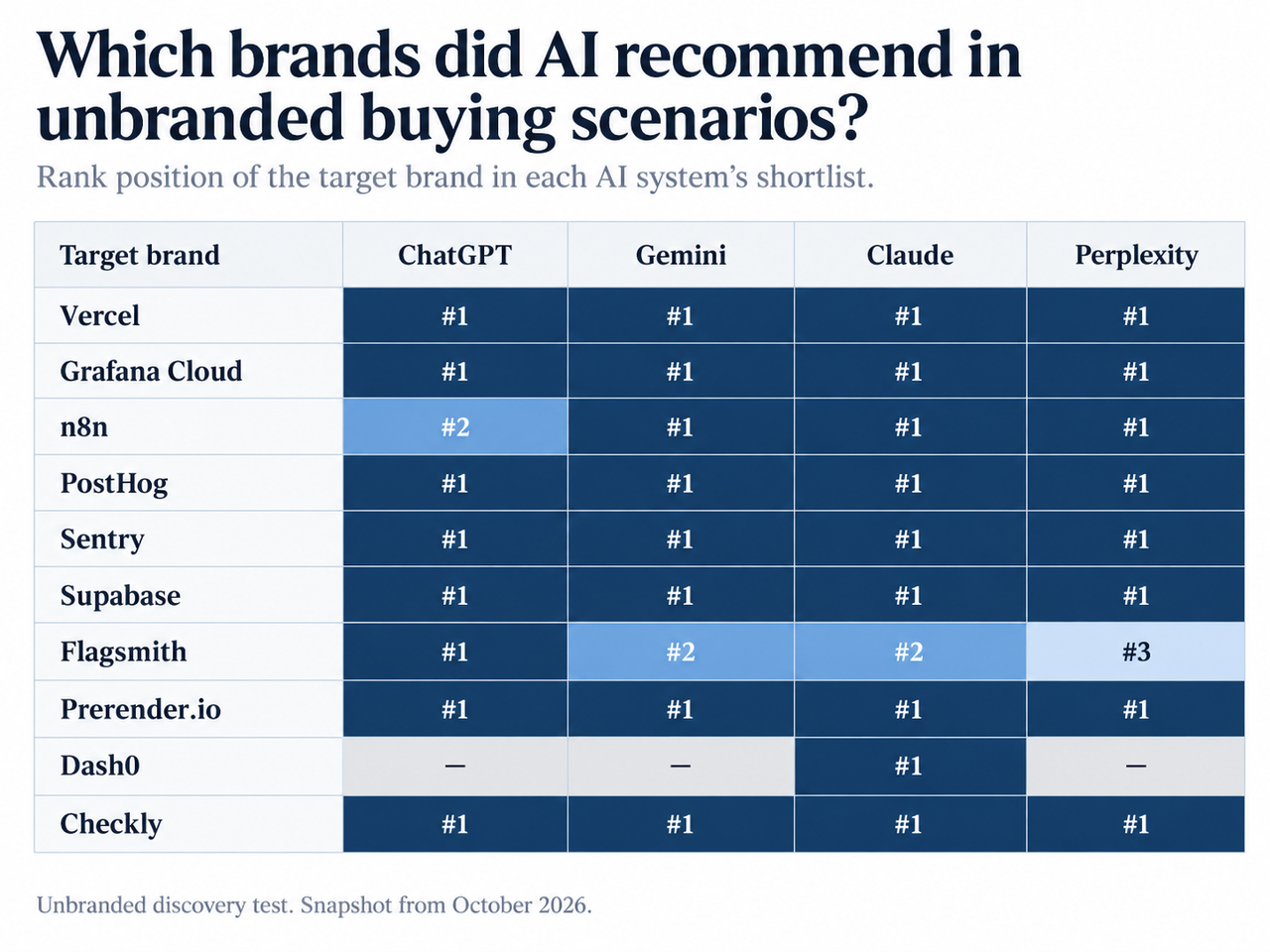
This exposed two different kinds of positioning lag.
One looks worse than it is.
The other looks harmless until a buyer asks for a recommendation.
Checkly: old language, strong discovery
Checkly was one of the clearest examples of narrative lag without discovery lag.
In the branded test, the AI systems mostly described Checkly using familiar category language: synthetic monitoring, browser and API checks, Playwright, and monitoring as code.
That description is still technically accurate.
But Checkly’s current homepage has moved the narrative further. It calls the product “the active reliability layer for developers & agents” and positions AI agents as participants in creating monitors, running checks, investigating problems, and operating reliability workflows.
If I stopped at the branded test, I would conclude that AI had not fully absorbed the repositioning.
Then came the unbranded test.
The scenario described a developer-led team that wanted Playwright-based browser and API monitoring, monitoring as code, and the ability for coding or AI agents to create and operate reliability workflows.
All four systems independently ranked Checkly first.
ChatGPT called it the “strongest fit by a wide margin.” Claude also ranked it first and explicitly connected Playwright-native monitoring with MCP and AI-oriented workflows. Perplexity reached the same conclusion.
So the wording was behind, but the association was not.
AI did not describe the company using its newest narrative, yet it still understood the underlying capabilities well enough to recommend it for the new problem.
That is annoying for brand consistency.
It is much less dangerous commercially.
Dash0: the opposite problem
Dash0 produced the more consequential failure.
The branded systems all knew Dash0 as an OpenTelemetry-native observability platform. That is a reasonable description of the company’s foundation.
But Dash0’s current product has moved aggressively into AI SRE.
Agent0 now continuously scans environments, investigates failures, connects telemetry to code, traces problems to specific commits, and can draft fixes as pull requests. With Automations, Dash0 says this loop can run without a person opening a chat.
So I created an unbranded scenario around exactly that newer category association: a cloud-native team standardized on OpenTelemetry that wanted an AI SRE for investigation, root-cause analysis, and increasingly autonomous remediation.
Only one of the four systems recommended Dash0.
Claude ranked it first.
ChatGPT instead ranked New Relic first and did not include Dash0 in the shortlist. Gemini recommended Resolve AI, Splunk Observability Cloud, and Kubiya instead. Perplexity returned Grafana Cloud, New Relic, Datadog, and Last9.
This is a different problem.
The AI systems knew the company.
They understood its established category.
But three out of four did not associate Dash0 strongly enough with its newer AI-SRE story to put it into the consideration set when the buyer described that problem.
That is what I would call discovery lag.
And discovery lag is much more commercially relevant than whether an AI assistant repeats the latest homepage tagline.
If buyers increasingly use AI systems to construct shortlists, a company can be well known and still be absent from the specific market conversation it is trying to enter.
Discovery is still not preference
Flagsmith showed a third pattern.
All four systems discovered it in the unbranded scenario about feature flags, remote configuration, gradual rollouts, auditability, regulated environments, and private or self-hosted deployment.
So discovery was not the problem.
Preference was.
Flagsmith ranked first in one system, second in two, and third in another. Gemini and Claude both put Unleash above it. Perplexity put both Unleash and LaunchDarkly ahead of it.
That gives us another distinction that simple “AI visibility” metrics tend to blur.
Being mentioned means the system knows you.
Being shortlisted means the system associates you with the buyer’s problem.
Being ranked first means the system believes you are a better answer than the alternatives it knows.
Those are not the same outcome.
A better model for AI brand visibility
The experiment left me with a four-layer model.
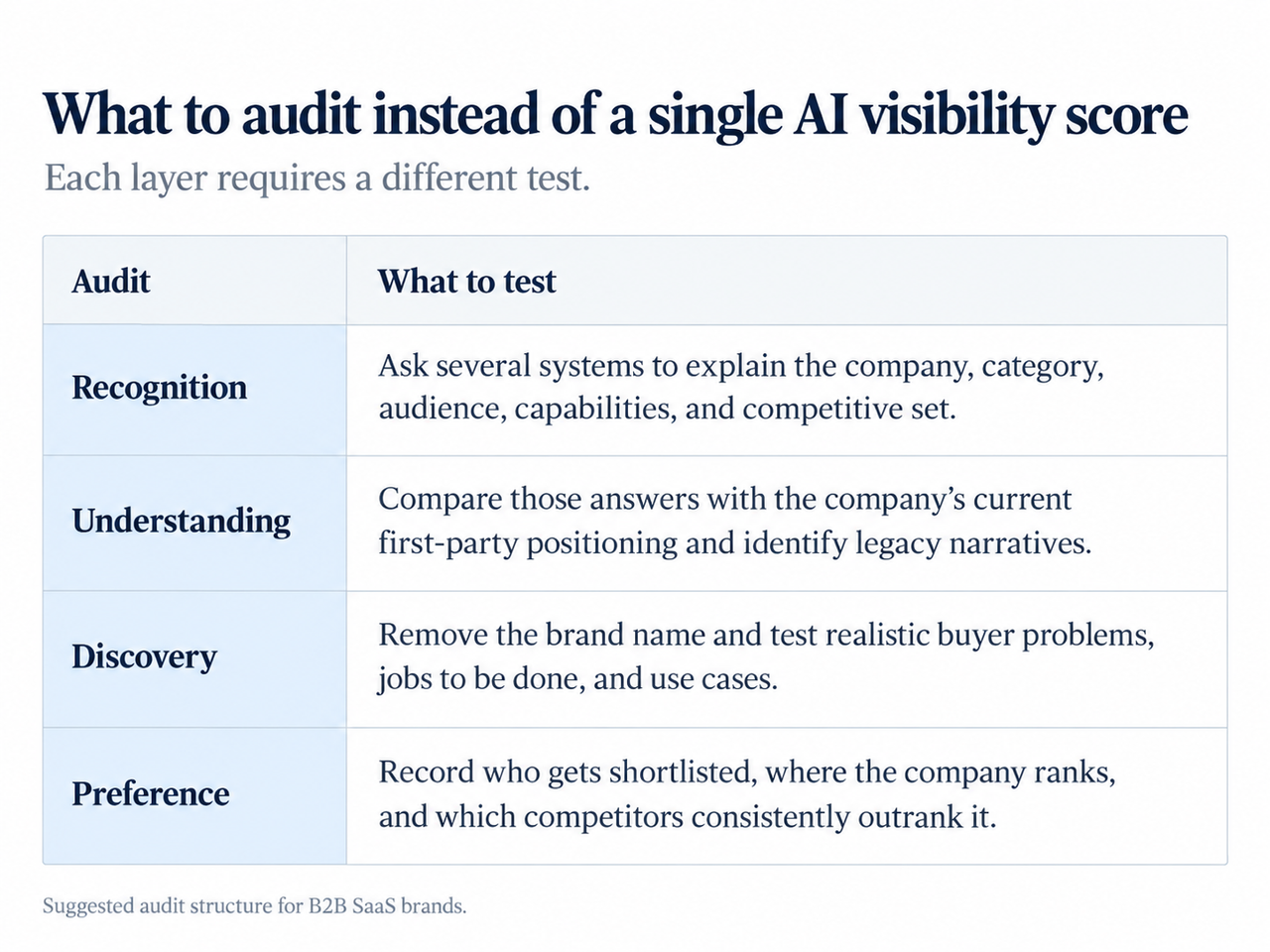
Most current AI visibility discussions focus heavily on the first layer and parts of the third: mentions, citations, share of voice, and prompt coverage.
Those metrics are useful, but they can hide very different business situations.
Checkly had imperfect narrative freshness but excellent discovery and preference.
Dash0 had recognition but weak discovery for its newer positioning.
Flagsmith had excellent discovery but weaker relative preference.
Vercel had clear narrative lag in some branded responses but still dominated the buyer scenario: all four systems ranked it first.
A single visibility score would flatten all four of those situations into roughly the same thing.
They are not the same thing.
The website is not the only thing teaching AI what your company is
Another pattern in the responses was source inconsistency.
Some systems retrieved current first-party materials. Others leaned heavily on comparison pages, third-party profiles, older articles, or pages written around the company’s previous positioning.
That makes intuitive sense.
A company rarely has one clean definition distributed across the web. It has a homepage written this quarter, an About page written two years ago, comparison pages optimized around an old category, review-site descriptions, LinkedIn copy, documentation, launch posts, partner pages, and thousands of external references.
Vercel is a useful example because both stories are simultaneously available on the public web. Current company materials make agentic infrastructure central. Yet “frontend cloud” remains deeply embedded in its historical content footprint and in the language other sites use to describe it.
An AI system retrieving the live web can therefore still produce a stale answer without hallucinating anything.
It simply retrieves a different version of the company.
This experiment cannot prove which source caused each answer. The systems have different retrieval architectures, and the model’s internal knowledge also matters.
But it does suggest a more practical question for marketers:
How consistent is the evidence about your current positioning across the surfaces an AI system might retrieve?
That includes the company website, but it does not stop there.
What I would audit instead of “AI mentions”
If I were assessing a B2B SaaS brand now, I would not start with a single visibility number.
I would build the audit around the four layers.
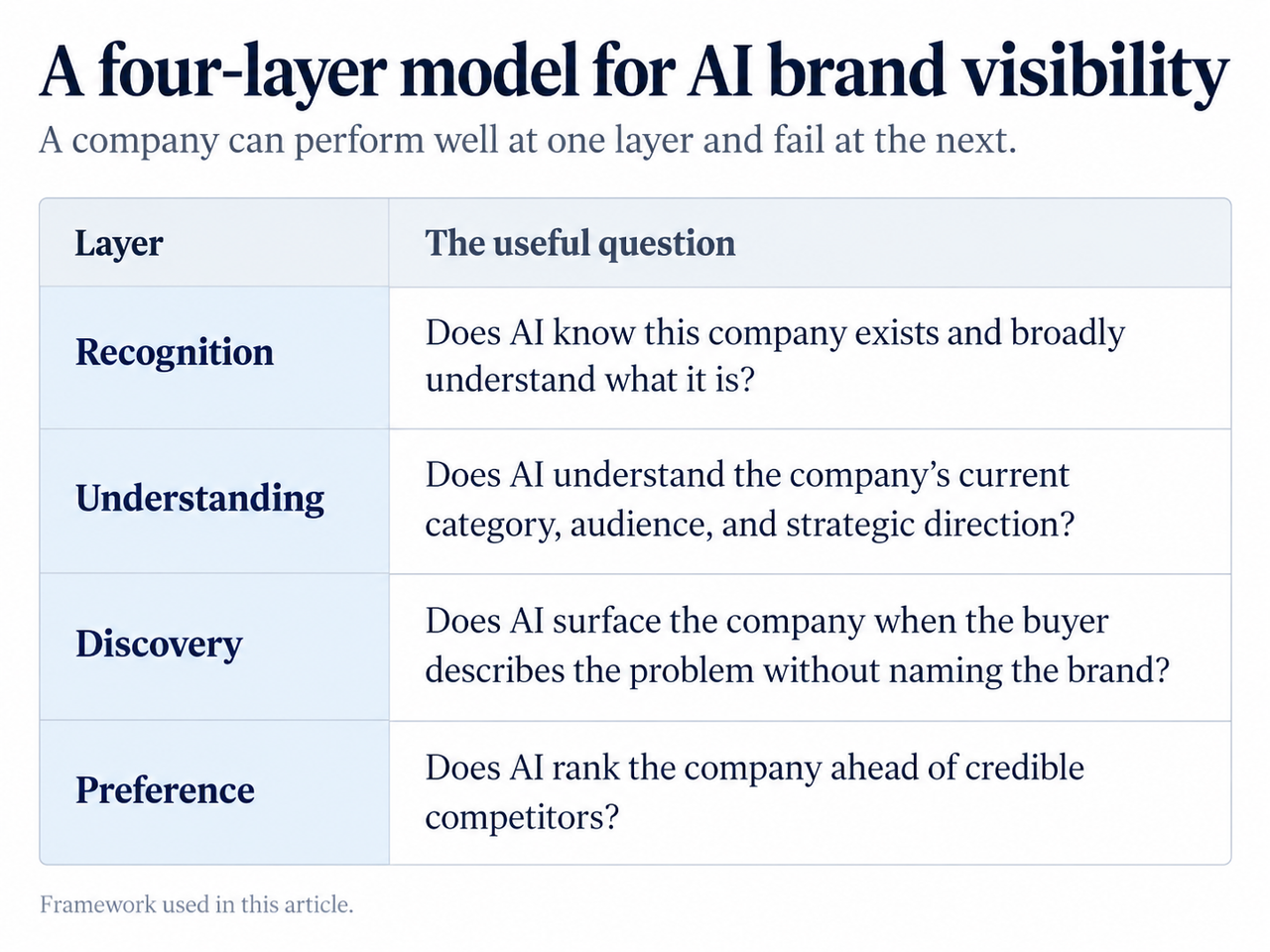
Then I would inspect the gap.
If AI uses old language but still recommends the company for its new use cases, the problem is mostly narrative consistency.
If AI knows the company but fails to surface it for the market the company is actively trying to enter, that is a more serious positioning and demand-capture issue.
If the company is consistently shortlisted but loses to the same competitor, the problem shifts again. Now the question is what evidence, positioning, proof, or perceived capabilities are giving the competitor an advantage.
That is more actionable than asking whether ChatGPT mentioned the brand 437 times last month.
What this experiment does not prove
This was an exploratory study, not an industry benchmark.
The sample contained 10 technical B2B SaaS brands, not hundreds of companies across multiple markets. Each system was tested once per prompt, while generative answers can vary between runs.
The AI products were also not configured identically. ChatGPT used reasoning and live retrieval in the run I tested, Claude explicitly answered some prompts from existing knowledge without a live search, and the other systems had their own retrieval behavior.
The unbranded scenarios were intentionally high-fit. They were designed to test whether AI could connect a company with a problem that closely matched its current product story. A generic prompt such as “What are the best observability tools?” would measure something different and would probably favor market incumbency much more heavily.
The study therefore does not show that a target brand will appear in 92.5% of arbitrary real-world AI buying conversations.
It shows something narrower and, I think, more useful:
When I removed the brand name but preserved a close match to the company’s current value proposition, most brands were still discovered. When they were not, the failure exposed a real gap between what the company was trying to become and what AI associated it with.
The harder question is not whether AI knows you
The easiest state for a brand to measure is recognition.
It is also the least interesting.
The more consequential questions are whether AI understands what you are becoming, whether it connects you to the problems you want to own, and whether it prefers you when the buyer asks for alternatives.
Those layers can drift apart.
A brand can be known but outdated.
It can be understood but not discovered.
It can be discovered but consistently lose the recommendation.
That changes how I would think about AI visibility for B2B companies.
The goal is not merely to make the model mention your name.
The goal is to make the market evidence clear enough that, when a buyer describes the problem you are built to solve, AI knows that you belong in the answer.